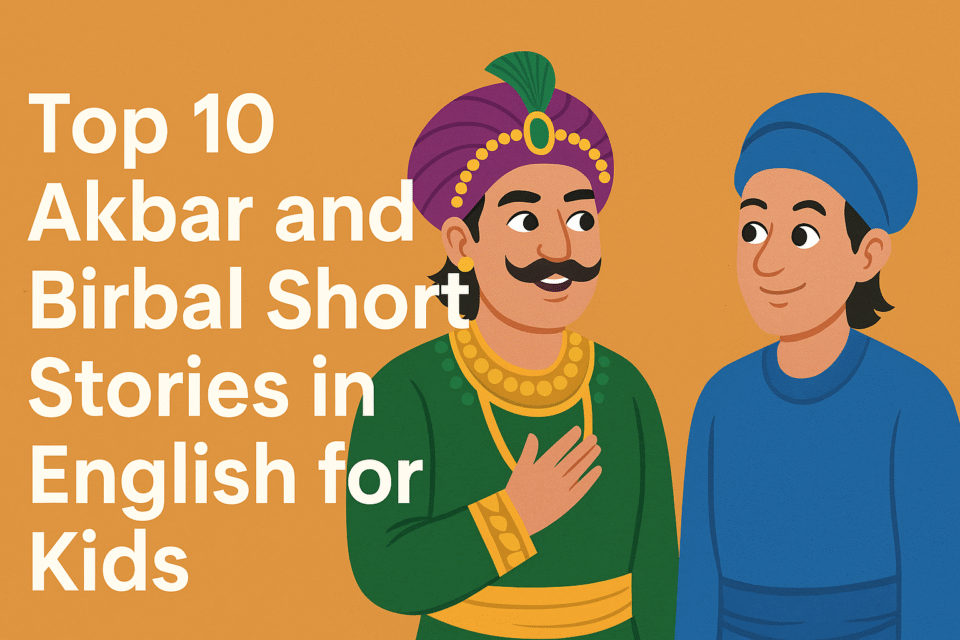
Stories have always been a powerful way to teach children wisdom, values, and the joy of imagination. Among India’s rich storytelling traditions, the Akbar and Birbal stories hold a special place. These tales revolve around the Mughal emperor Akbar the Great and his clever minister Birbal, known for his wit, wisdom, and presence of mind.
The stories are short, engaging, and humorous – making them ideal for children. More importantly, every story ends with a lesson that encourages kids to think critically and act wisely.
In this article, we bring you the Top 10 Akbar and Birbal short stories in English for kids. Each story is written in simple language so children can enjoy reading and parents can narrate them at bedtime.
Why Akbar and Birbal Stories Are Perfect for Kids
-
Easy to Understand: The stories use simple words and relatable situations.
-
Humorous and Fun: Kids love the funny twists and witty replies of Birbal.
-
Moral Lessons: Every tale has a hidden message that helps children develop wisdom, honesty, and problem-solving skills.
-
Cultural Connection: They give children a glimpse of Indian history and culture.
Top 10 Akbar and Birbal Short Stories in English for Kids
1. The Crows in the Kingdom
One day, Emperor Akbar asked Birbal a strange question:
“How many crows are there in my kingdom?”
Birbal smiled and replied, “There are eighty thousand and one crows, Jahapanah.”
Akbar laughed, “How can you be so sure?”
Birbal replied, “If there are more, then relatives of crows must have come to visit. If fewer, then some must have gone to visit relatives.”
Moral: Presence of mind and clever answers can solve even impossible questions.
2. The Pot of Wisdom
Akbar once asked Birbal to bring him a pot full of wisdom. Birbal returned with an empty pot and said,
“This is wisdom – it never gets full. The more you try to fill it, the more space it makes for knowledge.”
Akbar was impressed and understood the deep meaning.
Moral: True wisdom has no limits. Learning never ends.
3. Birbal Identifies the Thief
One night, someone stole jewels from the royal palace. Akbar asked Birbal to catch the thief. Birbal gathered all the suspects and gave each one a stick. He told them the stick would grow by two inches overnight if they were innocent.
The next day, everyone returned with the same stick, except one man, whose stick was shorter. He had cut it, fearing it would grow. Birbal declared him the thief.
Moral: A guilty conscience always reveals itself.
4. The Farmer’s Well
A farmer complained to Akbar that his neighbor had sold him a well but later claimed that the water belonged to him, not the farmer.
Akbar asked Birbal to judge the case. Birbal said, “If you sold the well, you sold the water too. You have no right to the water anymore.”
Akbar smiled at Birbal’s wisdom, and the farmer got justice.
Moral: When you sell something, you sell it with all its parts and benefits.
5. The Half Sun and Half Shade Reward
Once, Akbar was very pleased with a man and promised to reward him with gold coins equal to the amount of land his shadow covered. The man came in the afternoon when the sun was bright and stretched his shadow far.
Akbar felt cheated and called Birbal. Birbal suggested, “Let the man take coins only for the part of his shadow that is under the sun, not the shade.”
Everyone laughed at Birbal’s cleverness.
Moral: Smart thinking helps solve tricky problems fairly.
6. Birbal’s Khichdi
On a cold winter night, a poor man was challenged to stand in the freezing river all night. In return, he would get a reward. The man succeeded, but Akbar refused to pay, saying he must have taken warmth from the moon.
Birbal taught the king a lesson. He started cooking khichdi in a pot hanging far above the fire. When Akbar asked why, Birbal said, “If the poor man got warmth from the moon, then my khichdi will cook from the faraway fire.”
Akbar realized his mistake and rewarded the poor man.
Moral: True effort should always be rewarded.
7. Akbar’s Lost Ring
Akbar lost his precious ring and suspected a courtier. He asked Birbal to find the culprit. Birbal looked around and said, “The thief has a straw in his beard.”
The guilty man immediately touched his beard in fear, and Birbal caught him.
Moral: Guilt makes people reveal themselves.
8. The Greedy Barber
Akbar once gave his barber a generous reward. The barber became greedy and asked for more. Birbal suggested the king make him a courtier.
Soon, the barber’s foolishness was exposed as he gave silly advice. Akbar realized greed can never bring wisdom and returned him to his old job.
Moral: Greed can never make a person wise or respectable.
9. The Mango Tree
Akbar and Birbal were once sitting under a mango tree. Akbar asked, “How many mangoes are there on this tree?”
Birbal replied, “As many as you count, Majesty.”
Akbar laughed, realizing Birbal had cleverly avoided an impossible question.
Moral: Wit and presence of mind are powerful tools.
10. The Four Fools
Akbar once asked Birbal to find the four biggest fools in the kingdom. Birbal brought four men:
-
A man who carried a lamp in daylight.
-
A man who looked for his camel while sitting on it.
-
A man who quarreled with his shadow.
-
And finally, Birbal himself.
When Akbar asked why, Birbal smiled, “Because I wasted my time searching for fools.”
Everyone laughed, and Akbar praised Birbal’s humor.
Moral: Humor and wisdom together can solve even the strangest challenges.
Lessons Kids Can Learn from Akbar and Birbal Stories
-
Quick Thinking: Birbal’s cleverness shows the power of using your brain.
-
Honesty: Many stories highlight the importance of truth.
-
Justice and Fairness: Akbar’s decisions guided by Birbal reflect fairness.
-
Humility: Even a king respected wisdom over power.
-
Problem Solving: Every tale inspires kids to think of smart solutions.
FAQs
1. Why are Akbar and Birbal stories good for kids?
They are short, simple, humorous, and always end with a moral lesson. Kids enjoy reading them while also learning values like honesty, fairness, and intelligence.
2. Are Akbar and Birbal stories real?
While Akbar and Birbal were real historical figures, most of these stories are folk tales created to highlight Birbal’s wit and wisdom.
3. What values do Akbar and Birbal stories teach children?
They teach honesty, presence of mind, respect for wisdom, problem-solving, and fairness in daily life.
4. Can Akbar and Birbal stories be used for bedtime reading?
Yes! They are short, funny, and thought-provoking, making them excellent bedtime stories for kids.
5. How do these stories help in child development?
They sharpen children’s thinking skills, encourage creativity, and strengthen moral values through engaging storytelling.
Conclusion
The Akbar and Birbal short stories are timeless treasures of Indian folklore. They combine humor, wisdom, and morals in a way that appeals to children and adults alike. For kids, these stories are more than just entertainment – they are lessons in wit, honesty, and fairness.
By sharing these top 10 Akbar and Birbal short stories in English for kids, we hope your little ones enjoy reading and also learn values that will stay with them for life.
